

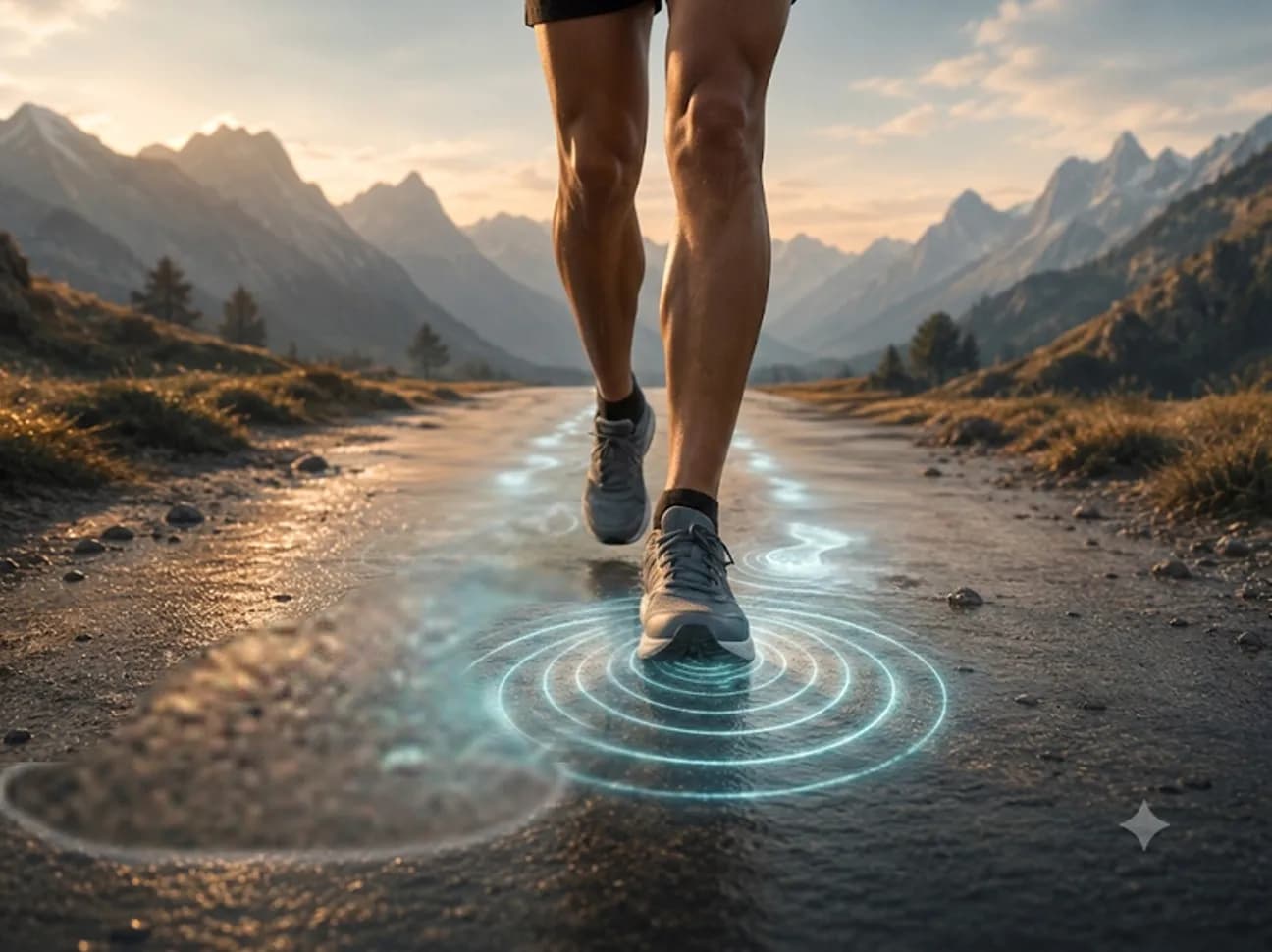
THE SCIENCE · GROUND_TRUTH™
Biomechanics: the science of how you move.
Your body is proof of who you are, and insight into how you are. Every step is a small feat of engineering, and biomechanics is the science that reads it. Understand your own movement and you gain something no password can give you: recognition that comes from your body, and stays with your body.
Gait science
What biomechanics is, and what gait is
On-device biometrics
Where your walk is read, and where it stays
Known, Not Shown
A yes or a no leaves the shoe, and nothing else
What is biomechanics?
Biomechanics is the science of how bodies move. Walking is biomechanics. So is running, cycling, a beating heart, and the tissues flexing inside you right now. If it moves, biomechanics gives you a way to understand it, and a way to make it work better for you.
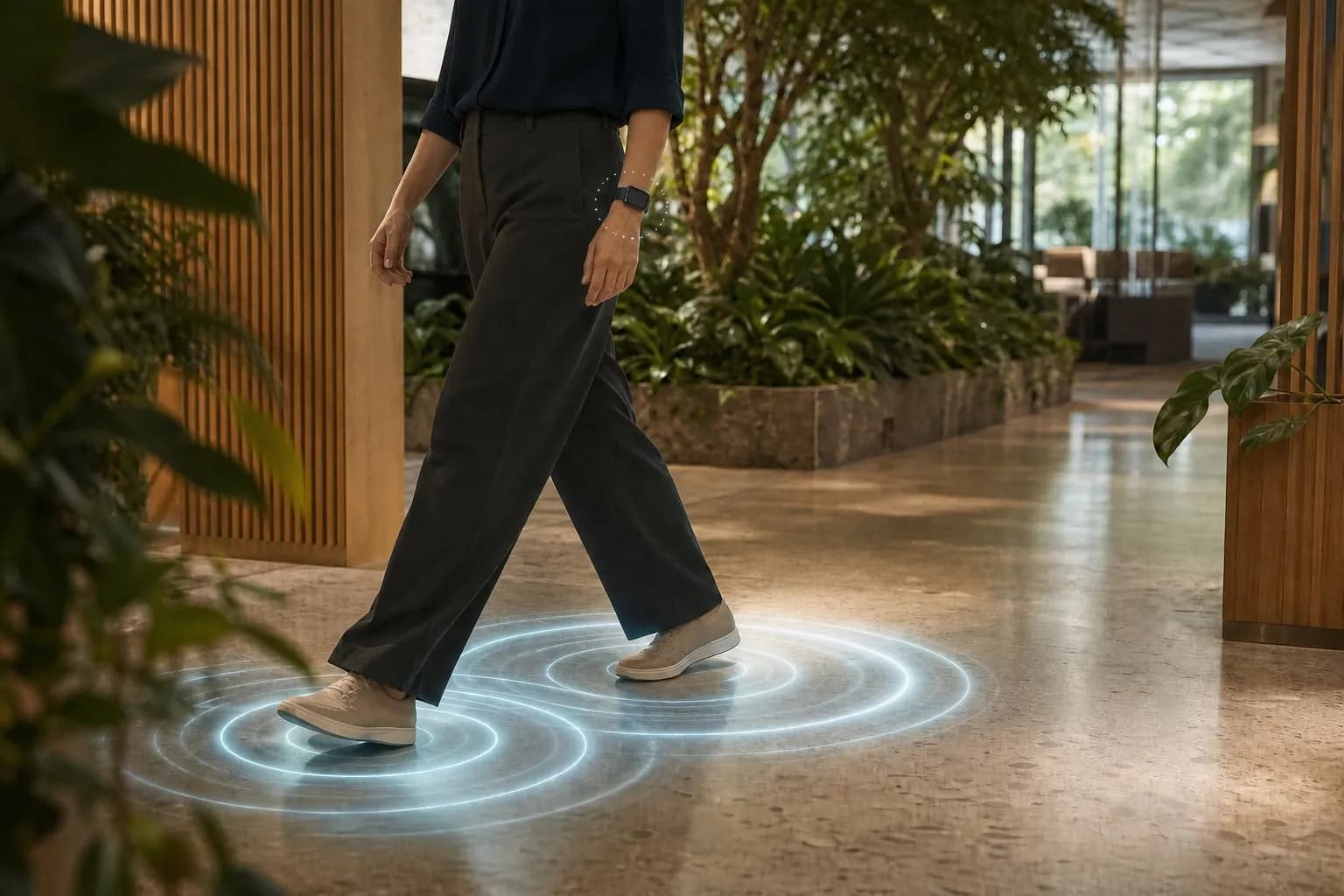
It is an old instinct made rigorous. People have always read each other's movement: a doctor learns a great deal simply by watching you walk across a room. Biomechanists turn that watching into measurement.
The advantage for you is numbers instead of impressions: figures that can be checked, compared and trusted, rather than a judgement you have to take on faith.
What is gait?
Gait is the scientific word for the way you walk. One full gait cycle runs from the moment your heel meets the ground, through the roll of your foot, to the push from your toes, and on until that same heel lands again. You complete thousands of these cycles a day without thinking about a single one.
Everyone's cycle has the same parts. No one performs them the same way. Your stride length, how you bear weight, how your joints move through, the timing of every phase: all of it is shaped by your body and your habits. Together they make a pattern that is recognisably, usably yours.

| Phase | Part of the cycle |
|---|---|
| Heel strike | Stance begins. The heel meets the ground. |
| Loading response | Stance. Your weight arrives on the foot. |
| Mid stance | Stance. The body passes over the foot. |
| Terminal stance | Stance. The heel lifts and the weight moves forward. |
| Toe off | Stance ends. The toes push off and the foot leaves the ground. |
| Initial swing | Swing begins. The foot travels forward, clear of the ground. |
| Mid swing | Swing. The leg passes through under the body. |
| Heel strike | The same heel lands again, and one full cycle is complete. |
How movement is measured.
Measurement used to mean booking a lab. It now means walking out of your front door, which is where your real movement actually happens.
For roughly five decades the gold standard has been optical motion capture. Reflective markers go on the body, cameras track them, and the result maps every joint through every phase of a stride. It is the same technology film and video game studios use to turn an actor's movement into animation.
Labs are precise, but life does not happen in a lab. So movement science moved to small wearable sensors that measure motion anywhere: on a sidewalk, on a trail, across a full day rather than a five-metre walkway. You already own one. The same kind of sensor is in every smartphone, quietly noticing when you tilt the screen.
Your walk is yours alone. Written by your whole body.
Think about what has to line up for two people to walk the same way: the same foot, the same build, the same habits, formed over a lifetime. It does not happen. That is what makes gait different from every biometric you already know, and what makes it far harder for anyone to imitate.
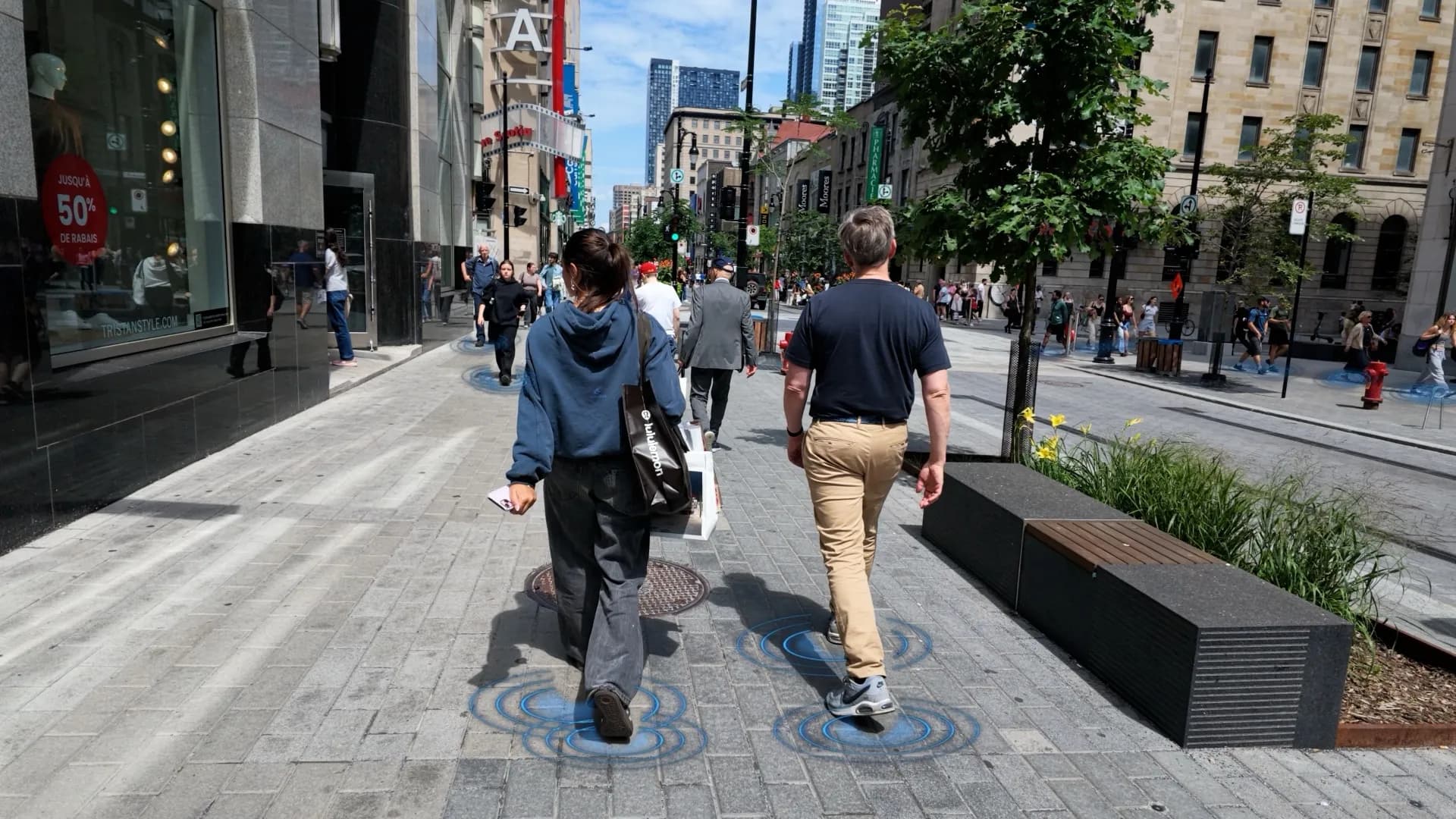
Montreal, captured.
Walk a street at this height and no two strides that pass you are alike.
i
A face can be photographed.
A fingerprint can be lifted from a glass. A voice can be mimicked by software in seconds.
ii
Those biometrics are images and recordings.
And images and recordings can be copied.
iii
Nothing is stored as a picture of you.
So there is nothing to lift, photograph or replay.

Your shoe size differs. Your foot is different. How you walk is drastically different. All of these combine, and it becomes very difficult to spoof.
What Bio_Sole builds.
Designed the other way around.
Most identity systems work by keeping a copy of your body: a photo of your face, a scan of your iris, a print of your finger. That copy sits in a database someone else owns, and can lose, sell or have breached.
Our smart insole slips into an ordinary shoe and reads the way you stand, bear weight and move. It confirms you at the source, in your own shoe, with every step.
i
Nothing to hand over.
Your biometric stays on the device. The world only ever receives a yes or a no.
ii
Nothing to remember.
No password, no card, no phone in your hand. You are confirmed by walking.
iii
One signal, two truths.
The same walk that proves who you are also carries general insight into how you are, day to day, shared as observations, not diagnoses.
Known, not shown.
There is no picture of you to steal, because there was never a picture of you at all. Your wellness story belongs to you, and it stays yours.
Bio_Sole is a general wellness product, so what it offers is observations rather than diagnoses. The insight it gives you is designed to be useful day to day, not clinical.
Questions people ask us.
What is biomechanics?
Biomechanics is the science of how bodies move. It studies anything that moves: how it moves, what it needs to move, and how to help it move better. Walking, running and cycling are all biomechanics, which is why it can tell you something useful about your own everyday movement.
What is gait?
Gait is the scientific word for the way you walk. A full cycle runs from heel strike, through toe off, to the next landing of the same heel. Everyone's cycle has the same parts, but no two people perform it the same way, so your cycle works as a signature.
How do scientists measure movement?
For decades, motion capture labs tracked reflective markers with cameras. Today, small wearable sensors measure movement anywhere, in real life rather than in a lab. The same kind of sensor sits in every smartphone, which means your movement can now be measured where you actually move.
Is the way I walk unique?
Yes. Your foot shape, your build and habits formed over a lifetime combine into a pattern that belongs to you alone. That is why gait can identify a person, and why it is very difficult to fake.
How does Bio_Sole use biomechanics?
Our smart insole reads the way you stand, bear weight and move, and is designed to confirm that you are you with every step. Nothing to type and nothing to carry: the biometric stays on the device, and the world only ever receives a yes or a no.
Where is my biometric data stored?
On the device. There is no copy of your face, fingerprint or walk in a database, so there is nothing for anyone else to lose or leak. Identity is confirmed at the source, and only a yes or a no crosses the boundary. We call this Known, Not Shown.
Ask the scientific question.
If something on this page oversimplified the science, or you want to see the measurement applied to your own movement, tell us. We would rather answer the harder version of the question.
Watch us earn it.
Ground_Truth™ is our podcast: a company asking itself the hard questions in public, with guests who have no reason to be gentle. Hear the science examined in the open in Season One, and decide for yourself whether we deserve your next step.